IRS.gov Homepage
Description
The IRS supports diverse taxpayer types (effectively all taxpaying citizens and businesses) and each has widespread and periodic annual needs. This IRS.gov homepage redesign initiative was to explore and determine which configuration or balance between taxpayer needs vs. audience-based models best served all audience types.
Challenge / Goal
To create a design solution that supports contextual and timely content to diverse taxpayer types with widespread and periodic annual needs in a manner that is understandable and relevant. Our specialized request was to create homepage models that focused on audience based solutions, to better understand how people self-identify with a specific audience or industry or if they identify across multiple groups all adhering to industry best-practices.
From Insight to Impact
Translating research, design, and storytelling into measurable outcomes.
Discover
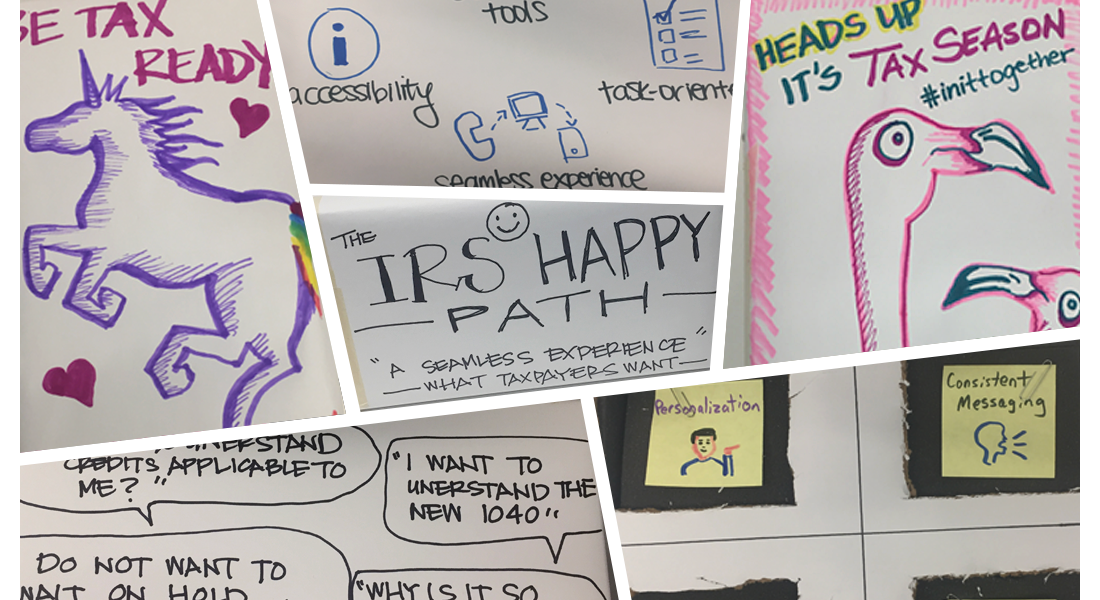
Led the strategic approach by initiating and facilitating two visioning workshops, the first designed to build stakeholder inclusion and generate shared excitement around the initiative, the second structured for cross-functional team planning. Synthesized diverse stakeholder perspectives into a clear design direction that balanced organizational priorities with real taxpayer needs.
Explore
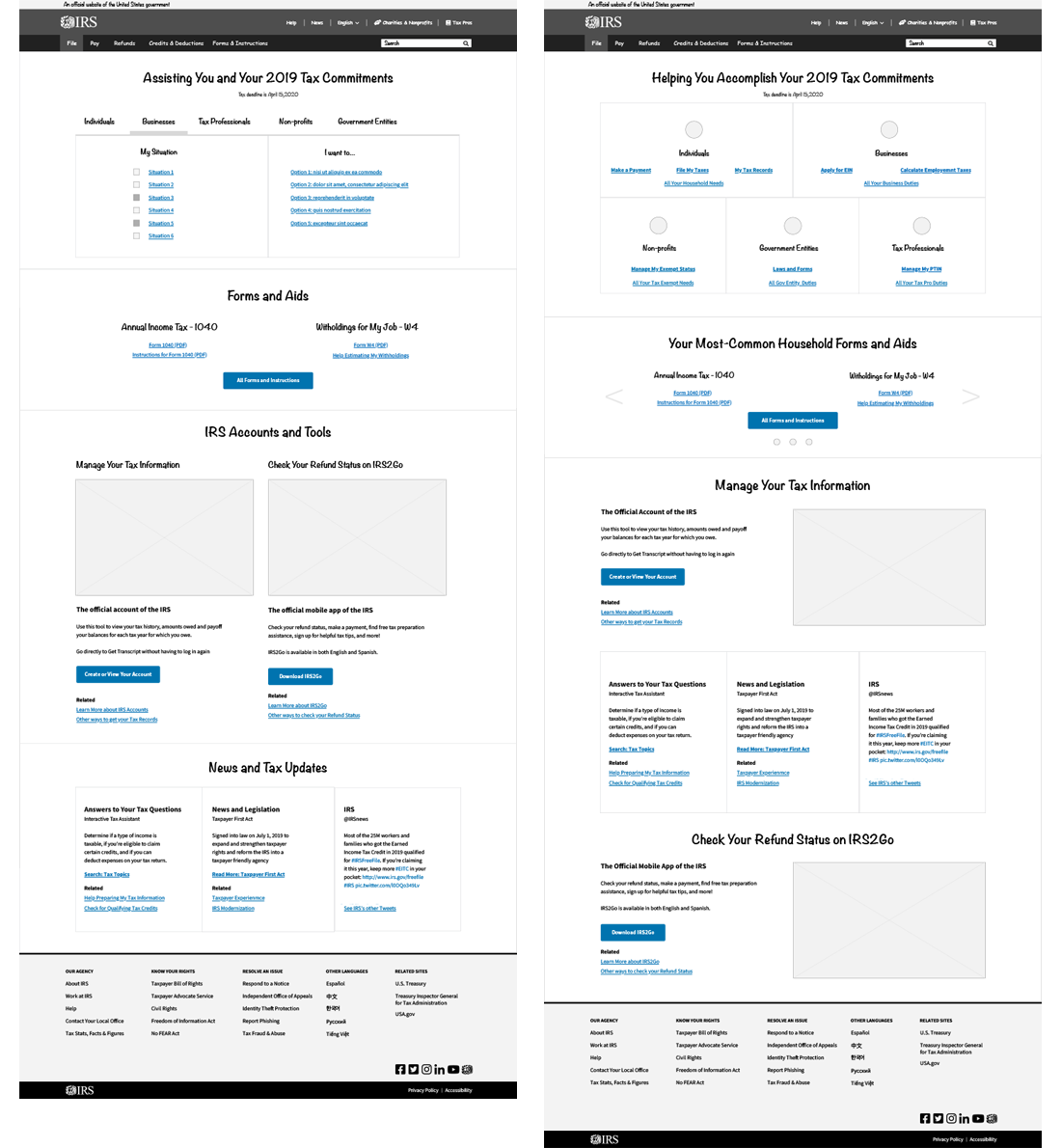
Directed a broad-to-narrow design process, from whiteboard exercises and paper sketches to low-fidelity digital models, generating multiple distinct homepage configurations for comparison. Each concept tested a different balance between audience-specific entry points and need-based content structures, enabling evidence-based decisions about what best served the full taxpayer spectrum.
Establish
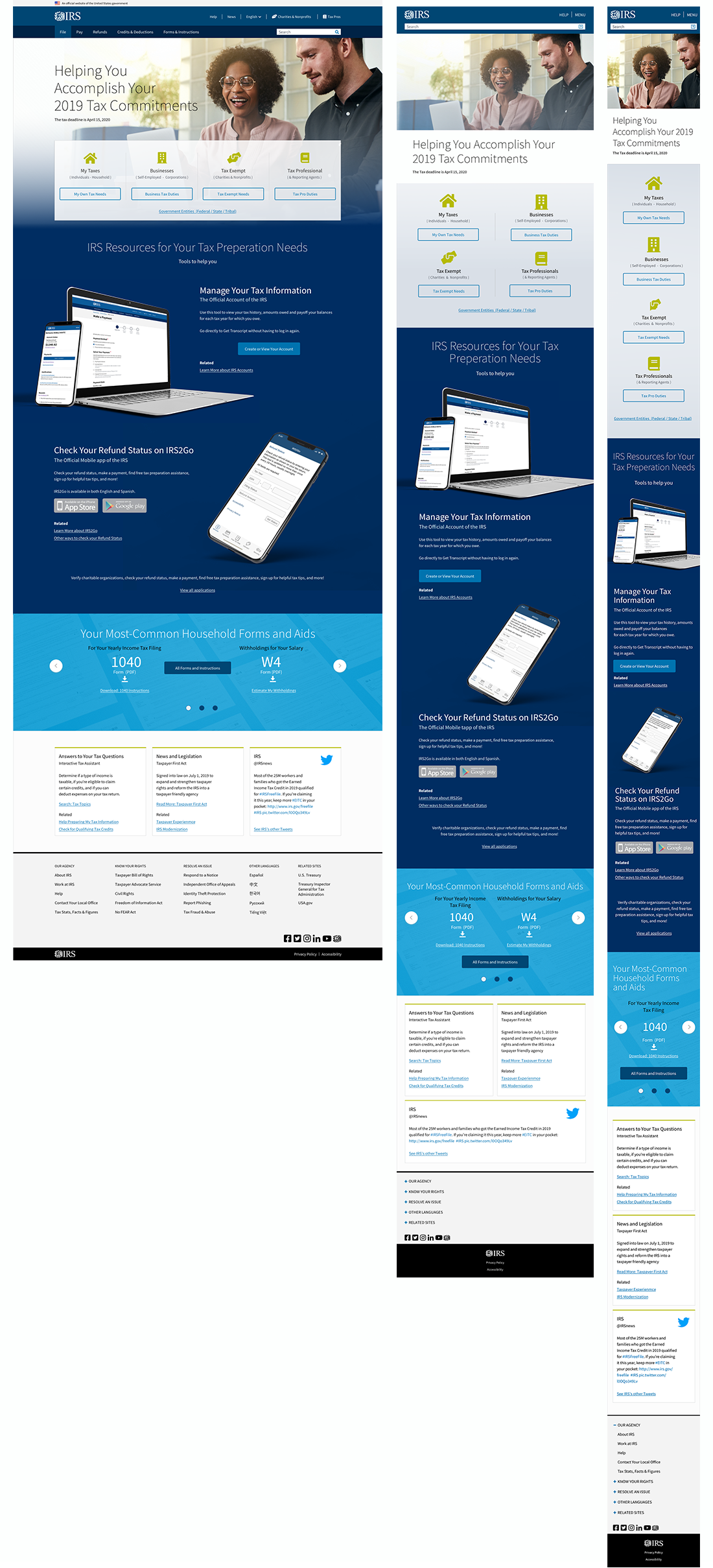
Elevated low-fidelity explorations into high-polish, production-ready models ready for formal and informal user testing. Partnered with research leads to structure evaluation criteria and ensure design concepts could be assessed against defined KPIs, creating a direct feedback loop between design output and measurable user behavior.
Results
- Established a scalable homepage framework that informed the current IRS.gov design direction
- Strengthened cross-functional alignment by grounding design decisions in shared research and workshop outcomes
- Enabled both formal and informal user testing cycles that directly shaped future homepage iterations
- Elevated the standard for audience-centered design at the IRS, demonstrating how self-identification patterns could guide information architecture at scale
Discover
Led the strategic approach including initiating and facilitating visioning workshops. The first was conceived to spark conversation, build inclusion, and generate excitement with stakeholders. The second was developed for the cross-functional team to discuss and plan an approach to develop a solution.
Role:UX Strategist, FacilitatorResponsibility:Team Lead | Creative and Strategic Direction
Explore
Started with a broad to narrow approach to construct numerous options to compare diverse design directions in multiple configurations. This process comprised of whiteboard exercises, paper sketches, and low-fidelity digital models.
Role:UX Strategist, UI / UX DesignerResponsibility:Team Lead | Creative and Strategic Direction
Establish
Leveraged low-fidelity models to explore visual designs resulting in a high-polished model for user testing efforts.
Role:UI / UX DesignerResponsibility:Team Lead | Creative and Strategic Direction
Measure
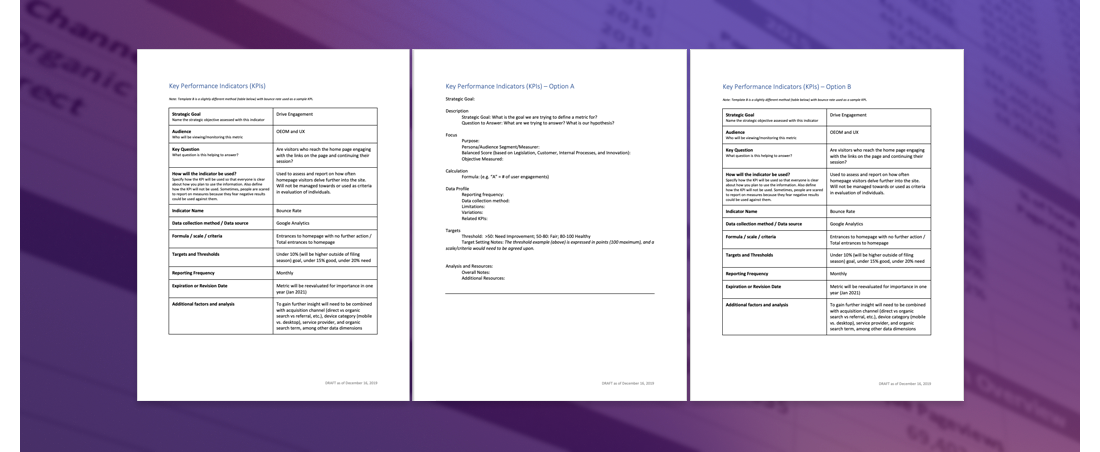
Constructed performance based KPIs and metric criteria. Design concepts were evaluated through formal and informal user testing efforts which informed future iterations and the current IRS.gov homepage design.
Role:Leadership (current), UX Strategist (initial)Responsibility:Team Lead | Creative and Strategic Direction
Reflection
This initiative was fundamentally a question about identity, how do people recognize themselves in the experience a government website offers, and how does that recognition shape their ability to find what they need? Designing for the entire taxpaying public meant holding enormous complexity without losing sight of the individual. The broad-to-narrow design process proved essential: by generating many divergent directions early, the team could make informed tradeoffs rather than defaulting to convention.
What made this work meaningful was its lasting impact. The concepts developed here didn't end with the project, they directly influenced the direction of the current IRS.gov homepage. That kind of continuity is rare in government design work, and it speaks to the value of grounding exploration in rigorous research, clear stakeholder alignment, and a genuine commitment to serving people over satisfying process.